3/19/2025
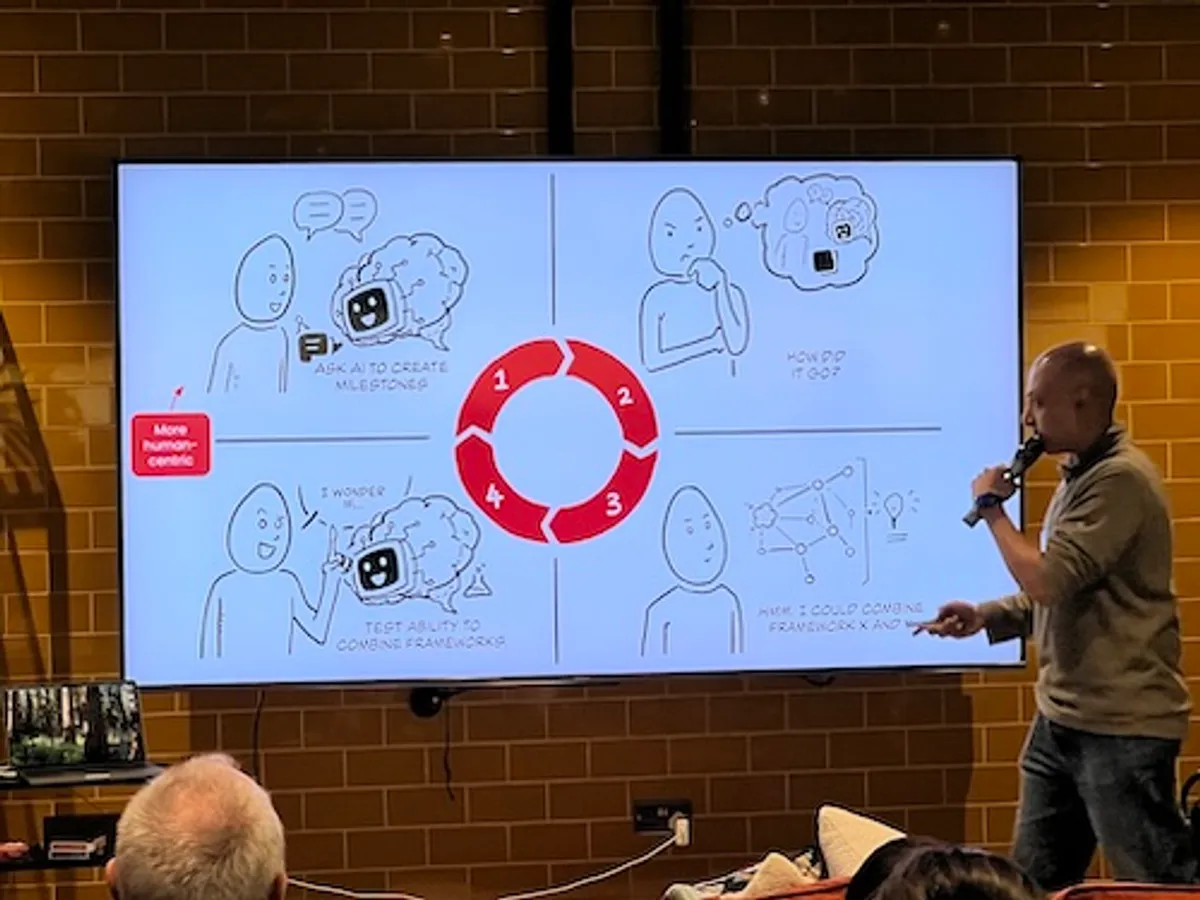
My talk at Experimentation London Meetup was about human-centric AI, and understanding how we do things so we can figure out the best fit for AI without letting AI take over.
It was a compressed version of my post on Humans + AI: Understanding The Thinking Partners, along with some elements of Thinking with AI.
But anyway, here is an AI summarisation of the talk (summarised using small models):
Summary of Iqbal’s Talk: “AI as a Collaborator, Not a Crutch”
Core Problem
- AI isn’t the issue—our relationship with it is
- Over-reliance on prompts to “fix” AI limitations
- Flood of AI slop (low-quality, homogeneous content):
- 60K+ AI-generated news articles/day
- 34M+ AI images since 2022
- 47% of Medium posts AI-generated
- 90% of online content projected to be AI-generated by 2026
- Risk: Losing creative autonomy as humans outsource thinking
Why It’s Broken
- AI ≠ Human Thinking
- AI predicts patterns (like next comic panel) but lacks:
- Morals, culture, lived experience
- Authenticity, nuance, unexpected connections
- We treat AI as a magic button, not a collaborator
- AI predicts patterns (like next comic panel) but lacks:
My Journey to the Solution
- Experimentation Consultant → Helped teams extract insights from data
- AI Workshop Experiment → Used AI for research/ideation
- Playbook Development → Framework to use AI while retaining human voice
- Inspired by Steve Jobs: “Creativity is connecting dots”
- AI excels at associations; humans bring unexpected connections
3 Modes of Human-AI Interaction
| Mode | Role of AI | Best For |
|---|---|---|
| Human-Centric | Supports human intuition (validate, critique) | High-stakes decisions, creative work |
| AI-Centric | Handles repetitive/low-risk tasks (research, restructuring) | Efficiency, data-heavy work |
| Synergistic | Balanced partnership (bounce ideas, shared decisions) | Innovation, complex problem-solving |
The Framework: Kolb’s Learning Cycle
To avoid blind AI reliance, structure interactions in 4 stages:
- Concrete Experience → Engage with AI output (e.g., milestones it generates)
- Reflective Observation → Critically examine: “Does this align with my goals?”
- Abstract Conceptualization → Connect to broader frameworks (e.g., combine AI + human expertise)
- Active Experimentation → Test, iterate, refine (e.g., tweak prompts or outputs)
Why This Works ✅ Forces human oversight (no passive reliance) ✅ Encourages rapid feedback loops (learn while doing) ✅ Ensures AI augments, not replaces, creativity
Final Message
- Not about “better prompts” → About better collaboration
- AI as a tool, not a replacement
- Structure interactions (modes + Kolb’s cycle) to preserve human creativity